

For small business owners, entrepreneurs, and high-earning professionals, the goal of retirement planning is two-fold: growth and tax efficiency. As you watch your business grow and your tax bill rise, you constantly seek vehicles that can amplify returns while shielding them from the IRS.
Enter the Crypto IRA. This vehicle, a specialized type of individual retirement account (IRA), marries the disruptive, high-growth potential of digital assets like Bitcoin with the undeniable power of tax-advantaged investing. But should a volatile asset like cryptocurrency belong in a sacred retirement nest egg? The skepticism is warranted.
In a rapidly evolving financial landscape, particularly with new IRS reporting requirements (like Form 1099-DA starting in 2026 for brokers) and institutional adoption from major firms like Fidelity, the answer is more nuanced than ever. This guide will cut through the noise, examine the concrete benefits and serious risks, and provide a clear, actionable roadmap for establishing your Crypto IRA in 2026.
The Great Advantage: Why Combine Crypto with an IRA?
A Crypto IRA is appealing because it lets you invest in cryptocurrency without paying capital gains tax. Unlike a standard investment account.
Tax-Advantaged Growth: The Game-Changer
In a normal brokerage account, every time you sell Bitcoin for a profit, exchange one cryptocurrency for another (like converting Bitcoin to Ethereum), or even use crypto to buy goods, you trigger a taxable event. These frequent transactions can result in significant tax drag, slowing down your compounding returns.
A Crypto IRA (a form of self-directed IRA) changes the rules of the game:
- Tax-Deferred Growth (Traditional IRA): With a Traditional IRA, contributions may be tax-deductible in the present (lowering your current taxable income), and all capital gains and income earned from your investments in crypto are tax-deferred. You only pay income tax when you take distributions from a retirement account.
- Tax-Free Growth (Roth IRA): The Roth IRA is arguably the most powerful pairing. You contribute money you’ve already paid taxes on, but all growth from your digital asset investments—no matter how massive—is tax-free upon qualified withdrawal. If your $50,000 investment in bitcoin turns into $5 million over 20 years, that entire gain is shielded from the IRS.
LSI Keyword Focus: The power of tax-deferred and tax-free compounding is particularly compelling for small business owners and high earners who anticipate being in a lower tax bracket in retirement (Traditional IRA) or who want to lock in a zero-tax rate on what they believe will be explosive growth (Roth IRA).
Benefits for Small Business Owners & Retirement Funding
It offers special benefits to entrepreneurs and those who are saving for their own retirement.

1. Superior Compounding Power
For a long-term asset like Bitcoin, where the goal is often to hold for a decade or more, eliminating capital gains tax allows your money to work harder. The gains that would have been immediately taxed in a taxable account are instead reinvested, leading to significantly higher balances over the 20+ year horizon of a retirement account.
2. Portfolio Diversification & Inflation Hedge
Traditional IRAs are often limited to stocks, bonds, and mutual funds. A Crypto IRA allows you to allocate a portion of your wealth to an uncorrelated digital asset class. Bitcoin, for instance, has often acted as a non-traditional hedge against currency devaluation, giving your retirement account exposure to a new macro theme. A recommended allocation often ranges from 1% to 10% of the total retirement account.
3. Access to High-Growth Potential
Historically, cryptocurrency has delivered outsized returns compared to traditional assets during major growth cycles. The self-directed IRA structure lets you participate directly in this growth using tax-advantaged money.
4. Advanced Options: The SEP/SIMPLE Crypto IRA
If you’re a small business owner, you might already be using a SEP IRA or SIMPLE IRA. The crypto IRA platform ecosystem is evolving to allow these business IRAs to also be self-directed and hold digital assets, offering a powerful way to fund your own retirement with pre-tax business income.
The Skeptic’s Corner: Acknowledging the Risks
Any discussion about putting cryptocurrencies into your retirement fund must begin with a stern acknowledgment of the risks. Luca Financial always advocates for a clear-eyed approach.
1. Extreme Volatility
This is the most critical risk. Bitcoin and other cryptocurrency assets are subject to severe, rapid, and unpredictable price swings. A 50% drop in a short period is common in this space. If you allocate too much to your Bitcoin IRA, a major price correction could significantly derail your long-term retirement account plan.
2. Custody and Platform Risk
To comply with IRS rules, a Crypto IRA requires a specialized IRA provider or custodian. Unlike holding shares at Fidelity’s standard brokerage, the complexity of a digital asset custodian introduces a few risks:
- Platform Failure: If the specialized crypto IRA platform (like iTrustCapital or others) suffers a hack or operational failure, your assets could be at risk, as crypto is not federally insured like bank deposits.
- Higher Fees: Specialized custodians often charge higher account maintenance and trading fees than the $0 commission found at a standard Fidelity brokerage IRA for stocks. Be sure to compare annual fees and transaction spreads.
3. Loss of Tax-Loss Harvesting
A major advantage of holding crypto in a taxable account is the ability to use Tax-Loss Harvesting (selling at a loss to offset gains). Because IRAs are already tax-advantaged, this strategy is unavailable. This is a trade-off for the promise of tax-free growth.
4. Prohibited Transactions and IRS Compliance
The IRS has strict rules against “self-dealing.” With a self-directed IRA, you cannot do things like:
- Buy crypto from or sell crypto to yourself or a family member.
- Use your IRA-held bitcoin as collateral for a personal loan.
- Take personal custody of the private keys associated with your IRA’s digital asset.
Violating these rules will result in the immediate taxable disqualification of your entire IRA, leading to taxes and severe penalties.
How to Get Started with a Crypto IRA in 2026: A Step-by-Step Guide
The landscape for investing in crypto retirement has been simplified by the entry of major, regulated financial services firms.
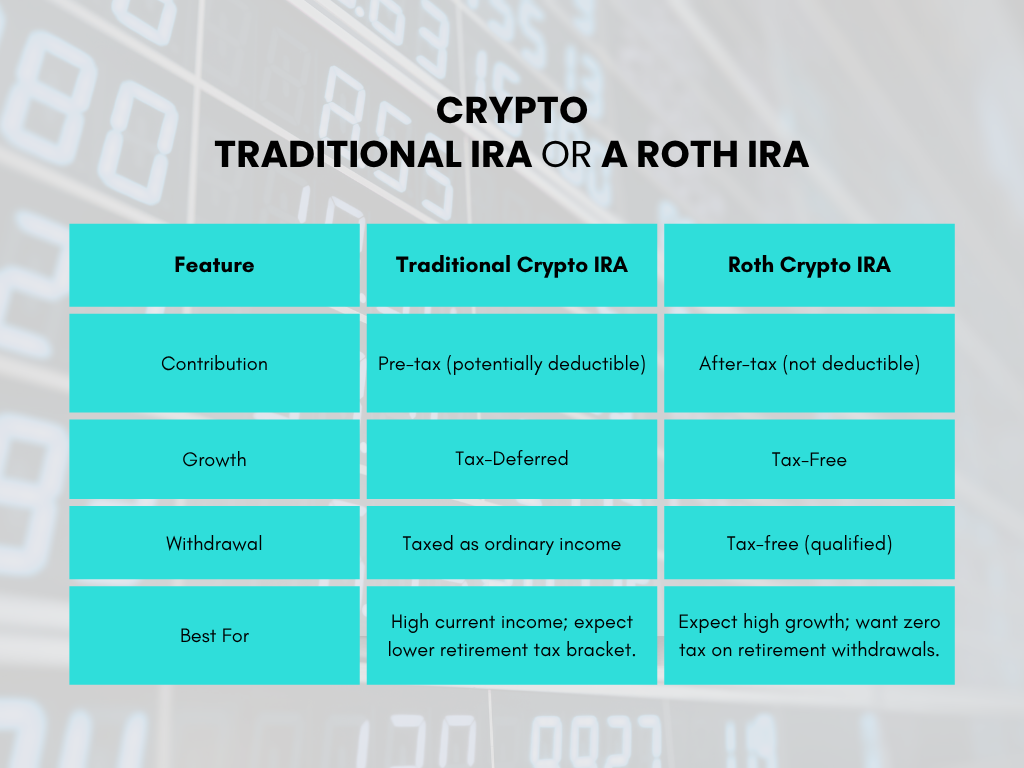
Step 1: Choose Your Tax Structure (Traditional vs. Roth)
Decide whether a Traditional IRA or a Roth IRA is right for you.
Step 2: Select a Qualified IRA Provider and Custodian
You cannot simply transfer your crypto from a Coinbase wallet into a traditional Fidelity account. You must use a specialized provider that acts as the custodian to ensure compliance.
- Full-Service Brokers: Major firms like Fidelity Digital Assets® now offer Fidelity Crypto® for IRAs, allowing you to directly invest in crypto (like bitcoin and Ethereum) within a linked Fidelity brokerage IRA. This offers the security and familiarity of an established financial services giant.
- Self-Directed IRA Platforms: Specialized companies (like iTrustCapital or Alto) focus solely on self-directed IRA alternative assets. These often offer a broader selection of cryptocurrencies beyond just Bitcoin, but may have higher fees and less integration with your overall financial portfolio.
Step 3: Fund Your New Retirement Account
The IRS is clear: You cannot transfer crypto you already own from your personal wallet into your new crypto IRA. You must fund it with cash. The three ways to fund your account are:
- Direct Contribution: Use earned income to make new contributions (subject to annual IRS limits).
- IRA Transfer: Move funds from an existing Traditional IRA or Roth IRA at a different IRA provider. This is a direct, tax-free transfer.
- Rollover: Move funds from a former employer’s 401(k) or other qualified plan into your rollover IRA at the new crypto IRA platform.
Step 4: Invest (And Rebalance) Responsibly
Once funded, you can use your crypto IRA platform to buy and sell crypto. Remember the risk. For most small business owners, an allocation of 5-10% of their total retirement account portfolio is a prudent starting point to capture the potential upside of the digital asset class while minimizing overall portfolio volatility.
The Verdict: Moving Forward in 2026
Is a Crypto IRA a good idea?
Yes—for the financially sophisticated, long-term investor with a high-risk tolerance and an existing, diversified retirement base.
For the small business owner seeking to maximize the compounding power of high-growth assets, the Crypto IRA represents one of the final, great tax-advantaged investment frontiers. By leveraging the tax-free growth of a Roth IRA with the volatility of Bitcoin, you create a powerful engine for long-term wealth creation.
However, success requires discipline, adherence to strict IRS rules, and meticulous selection of a reliable custodian. Do your research, understand the distinction between a traditional IRA and a Roth IRA, and approach your crypto retirement strategy with the same due diligence you use to run your business.
Need to integrate your Crypto IRA strategy with your business’s existing retirement plans (SEP IRA or Solo 401k)? Contact Luca Financial today for a personalized consultation on building a compliant and tax-efficient digital asset portfolio.
0 Comments