

Running a small business means balancing operational cash flow, client expectations, and growth roadmaps. With so many moving pieces, it is incredibly common for the annual spring deadline to arrive faster than your books can keep up. If you found yourself approaching the primary filing window with unreconciled accounts or missing documentation, you likely realized you needed to file an extension.
Requesting an extension of time to file is a standard, highly effective tactical maneuver utilized by thousands of entrepreneurs every year. However, many business owners treat a tax extension like a total pause button. They assume their responsibilities are frozen until the autumn calendar pages turn. In reality, the months between spring and fall represent a critical window. A strategic “Mid-Year Tax Reset” that can save your business thousands of dollars if handled correctly.
When is the 1040 Tax Extension Due Date?
For individual filers, sole proprietors, and single-member LLCs who submitted an official request using IRS Form 4868, the final timeline gives you exactly six months to file. This means your final, absolute deadline to submit a completed federal tax return is October 15, 2026.
While a six-month extension feels like an immense amount of breathing room. There is a fundamental rule that trips up small business owners every year. It’s thinking that an extension gives you more time to file your return, not more time to pay your tax.
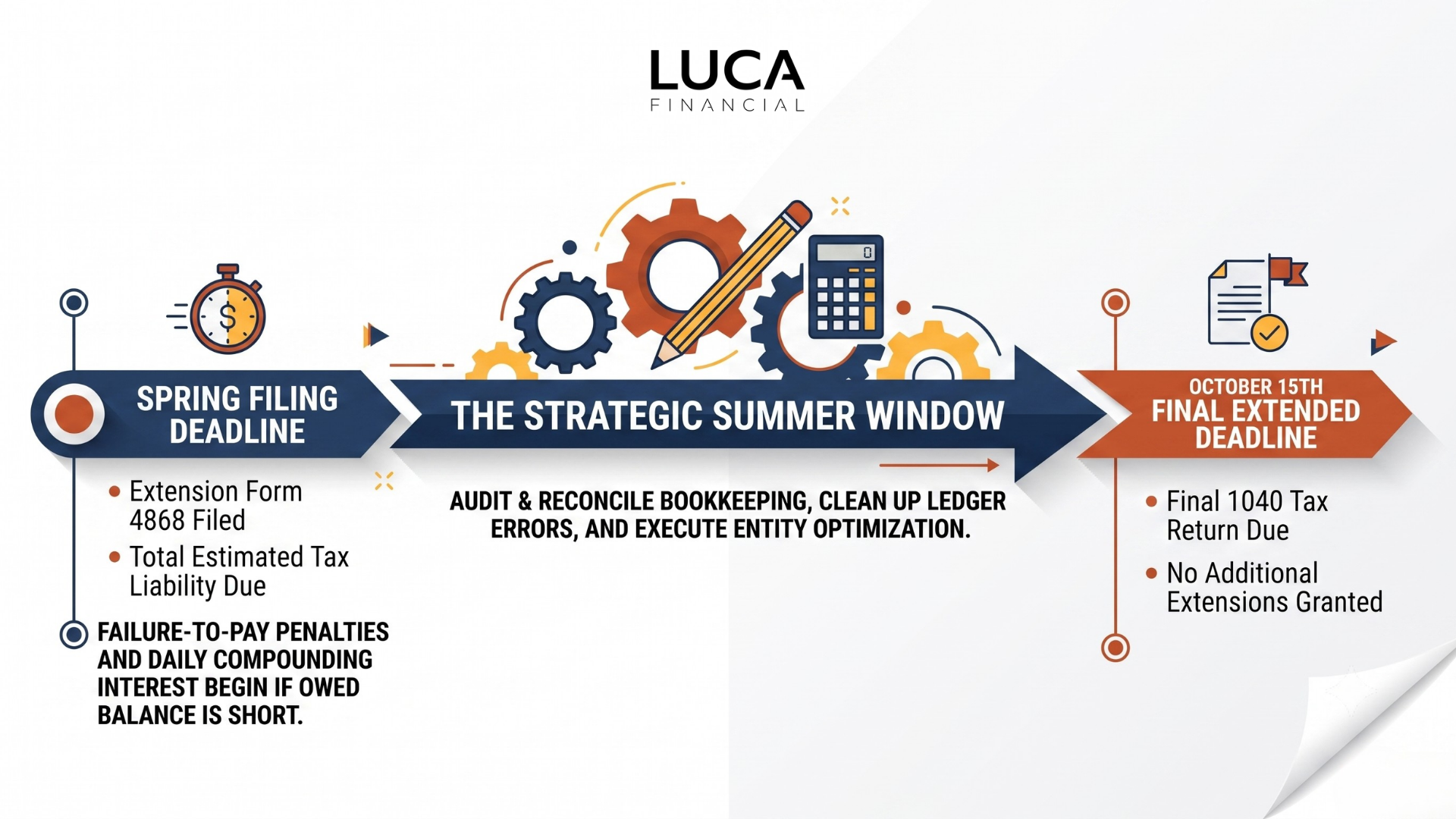
The IRS still expects you to have estimated your total tax liability. And that the balance is paid by the original April tax filing date. If you did not settle that tax due, interest and late-payment penalties will continue to compound throughout the summer months. To protect your corporate capital, you must establish an accurate view of your numbers right now rather than scrambling at the final hour.
Why a Late Filing is a Golden Opportunity for a Mid-Year Reset
Rather than waiting until mid-October to log into your financial portal in a panic, treating this summer window as an intentional “financial bridge” turns a basic compliance obligation into a massive competitive edge. When you look past the basic calendar requirements, a filing extension provides the precise breathing room required to execute three major operational upgrades before you file your tax return.
1. Comprehensive Bookkeeping Clean-up
During the absolute rush of peak tax season, minor errors are easily overlooked. The summer gives you the structural timeline to look closely at your inputs. Are your operational cash receipts categorized correctly? Did an automated software rule accidentally log a partner distribution or an owner’s draw as a standard business deduction? Taking the time to clean up these historical files now guarantees that when you are ready to file, your data is completely bulletproof.
2. Strategic Entity Optimization
Are you currently operating as a sole proprietorship when your net revenues suggest an S-Corporation structure would save you thousands in self-employment taxes? Mid-year is the absolute best time to evaluate your entity classification. A dedicated tax professional can review the financial data from the first half of the tax year to model exactly which structure will shield the highest percentage of your profit moving forward.
3. Dynamic Cash Flow Forecasting
Taxes should never be an isolated surprise that catches you off guard. By pairing your historical documentation with a forward-looking cash flow forecast, you can see exactly how much cash you need to set aside for both your final late return and your upcoming estimated quarterly payments.
Your Summer Tax Action Plan
To ensure your final corporate tracking remains elite and you avoid unnecessary IRS friction, execute these four tactical steps this month:
- Reconcile Through June: Ensure every corporate bank account, merchant processor, and business credit card statement is reconciled perfectly through the first half of the year.
- Estimate and Pay: If you realize you underestimated your initial payment back in the spring, submit a corrective electronic payment to the IRS immediately to stop the compounding interest clock.
- Run a Half-Year Profit and Loss (P&L): Sit down with your financial dashboard to analyze how your actual margins are stacking up against your initial projections for the 2025 tax year and beyond.
- Lock In Your Expert Support: Do not wait until the fall to find a professional. Reach out to an experienced team specializing in business tax preparation now to secure your spot before the autumn rush.
FAQs
Can you get an extension on your business tax return?
Yes. Depending on your business structure, you can secure an extension to file your corporate paperwork. While individual filers and sole proprietors use IRS Form 4868 for an automatic extension. Partnerships and S-corporations use Form 7004 to request a separate six-month timeline. Just like individual filings, a business extension only extends the time to file. It does not grant extra time to clear outstanding tax payments.
What is the $400 rule for self-employed people?
The “$400 rule” is a core IRS threshold. It states that if you earn $400 or more in net earnings from self-employment or independent contractor work, you must file a federal tax return. And also pay self-employment taxes. This applies even if your business is a part-time side hustle or temporary gig work. These earnings must be reported on a Schedule C using Form 1040. This contributes directly to your Social Security and Medicare obligations.
What are the 10 most overlooked tax deductions for small businesses?
Entrepreneurs routinely miss out on valuable deductions during the rush of standard tax preparation. The most common overlooked write-offs include:
- Home office deductions (calculated using the simplified or square-footage method).
- Professional development courses, books, and industry-specific training subscriptions.
- Out-of-pocket mileage logs for client meetings and business errands.
- Cell phone and internet percentages used exclusively for corporate operations.
- Section 179 deductions for purchasing corporate equipment, computers, or software.
- Bank service fees and interest accrued on business credit cards.
- Health insurance premiums paid for self-employed individuals.
- Qualified Business Income (QBI) deductions for eligible pass-through entities.
- Startup expenses incurred before the official launch date of the business.
- One-half of the self-employment tax liability calculated on your return
What is the secret $6,000 tax break?
In standard public forums, the “secret $6,000 tax break” typically refers to maximizing your traditional IRA or Health Savings Account (HSA) contributions. This directly reduces your adjusted gross income tax layout dollar-for-dollar. For many business owners, utilizing these standard pre-tax vehicles is the fastest way to trigger a higher tax refund. It can also lower an outstanding balance before finalizing an extended return.
Quick Reference Guide
- Do I need to file a state tax extension if I filed a federal tax extension?
This entirely depends on your specific state. Some states grant an automatic extension of time if you have already filed an IRS Form 4868 for your individual income tax return. Other states require a separate, independent state filing form to avoid late-filing penalties on your state income tax return. Always verify with a professional to make sure your state obligations are perfectly covered.
- Can I use tax software to file Form 4868?
Yes, modern tax software platforms can submit an electronic request for an extension to the IRS. Or, you can completely bypass the form by making a direct payment through the official IRS portal. Select “Extension” as the reason for payment. Then the system will generate a confirmation number. This grants you the automatic extension of time without any additional paperwork.
- What happens if I file tax paperwork late without an extension?
If you miss the deadline and fail to file Form 4868, the IRS can levy a failure-to-file penalty. This amounts to 5% of the unpaid taxes for each month the return is late. Filing an extension form completely protects you from this specific penalty. It keeps your business safe from unnecessary operational costs.
Take Control of Your Financial Strategy
Filing a 1040 tax extension is not an operational setback. It’s a premium tactical window to establish absolute structural clarity over your numbers.
By cleaning up your ledger, reviewing your margins, and modeling your mid-year cash flow, you ensure your business finishes the year stronger. This in turn helps you fully optimize for maximum profitability.
Are you currently moving forward on an extension and ready to clean up your corporate books? Let’s maximize your eligible deductions. Let’s cut accounting bottlenecks and build a proactive wealth roadmap.